Knock Knock Knock:
Sound Based Performance Series
Three sound-based works exploring war, inherited grief, and the experience of emigration
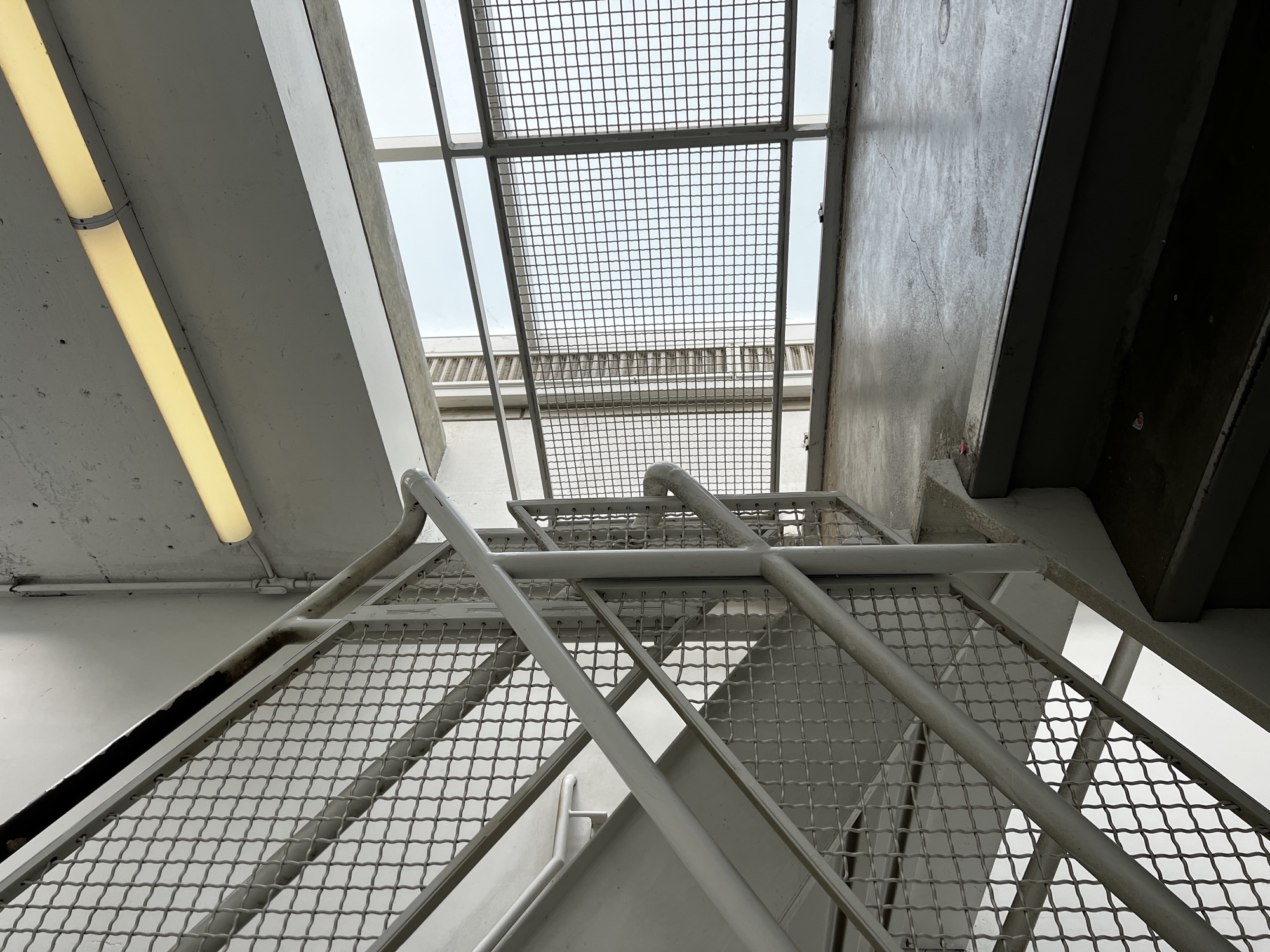
A looping audio of knocking, hidden within the stairwell architecture so its source cannot be found. Visitors moving through the space hear the sound but cannot locate it, and the search for its origin becomes part of the work. The sound was placed in a transitional space that people pass through without stopping, so the encounter with it is incidental, unrequested.
The piece comes from the experience of living at a distance from danger while it remains close. Growing up in a place where war is not abstract, and returning home only briefly, the work sits in that particular tension of guilt and gratitude, fear and the discomfort of safety. The knocking does not escalate or resolve; it continues at the same volume and pitch, indifferent to whoever is listening, which is part of what it means to live alongside a war that does not feel entirely yours to claim and yet does not feel separate from you either.
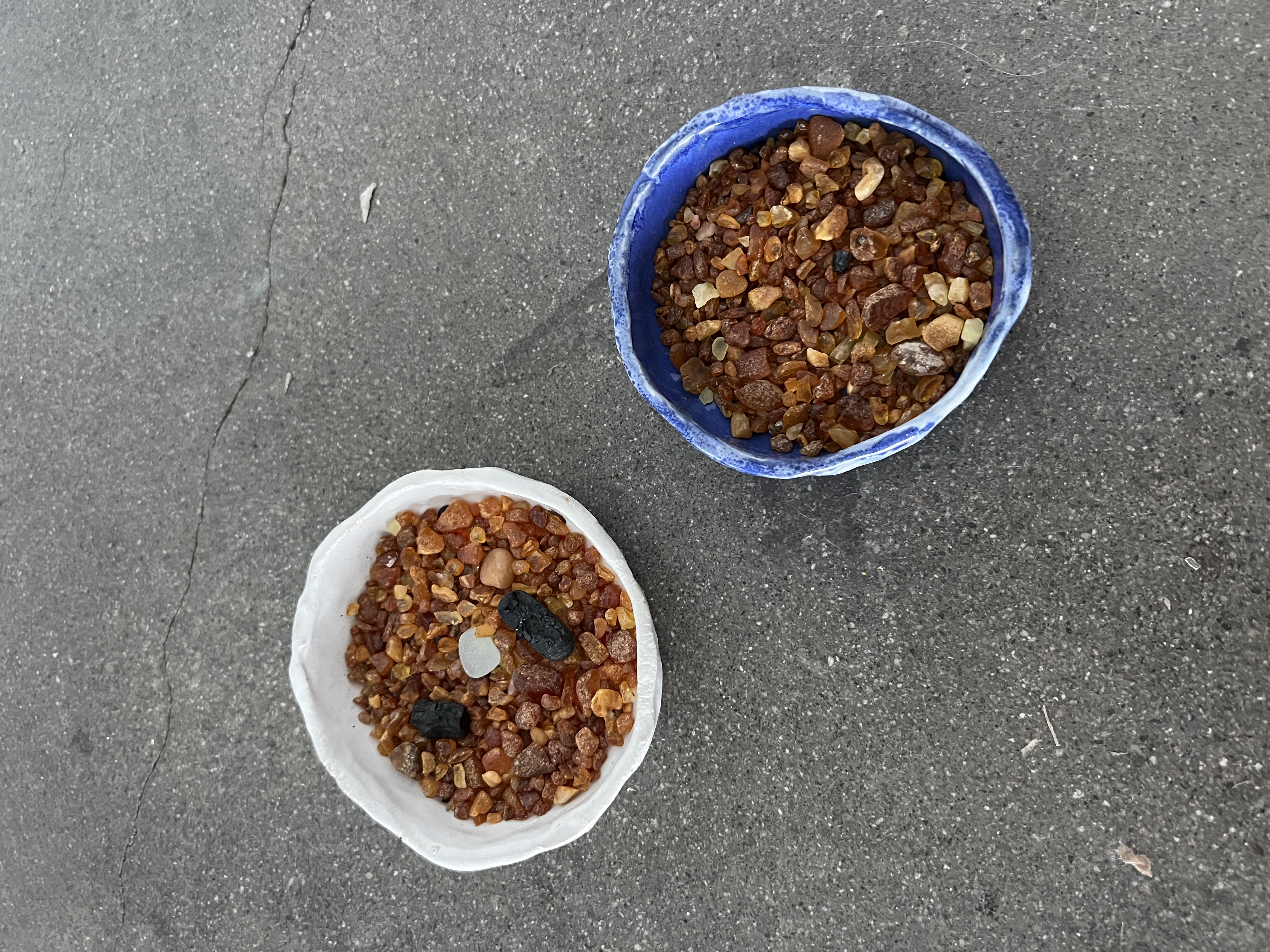
Two speakers facing each other, playing a stretched and distorted recording of a 54-minute conversation with my grandmother. Between them, two small ceramic bowls on the floor, one representing the sun and the other the moon, both filled with amber she collected on the shore of the Baltic Sea in Palanga, Lithuania. The title, material list, and date were printed and pinned to the wall above one of the speakers, and the bowls were made by hand, their imprecision deliberate, forms shaped by care rather than precision.
The amber holds time physically, and my grandmother's habit of gathering it felt like an act of quiet accumulation, grief made into something you can hold. Her voice in the recording is stretched beyond recognition and yet still hers. The bowls sit as offerings, as a vigil, and kneeling to look at them is part of the work. The amber itself ranges in color from pale honey to deep rust, each piece a fragment washed ashore and kept, the sea's record and hers at once.
The piece grew from gratitude, from wanting to acknowledge what passes down through women in families: not only tenderness but the weight of it. The title means exactly what it says, that depression can be a form of inheritance without being only a wound, that it arrives alongside something else, a sensitivity, a way of noticing, a particular kind of love. The work asks viewers to sit with both the difficulty and the tenderness without collapsing one into the other.
A travel bag, placed and then opened. Inside: personal belongings, Lithuanian books, gifts intended for friends who share my background and friends who do not, objects chosen for the comfort they carry precisely because they are familiar and, to those who grew up with them, unremarkable. Each object was selected for what it carries rather than what it is, the specific weight of the ordinary when it is taken out of context and placed somewhere foreign.
The word "emigrant" holds specific weight in Lithuanian, used often and not gently, carrying undertones of betrayal and the privilege of leaving. To leave is to be accused of abandonment, even when leaving is necessity, even when it is survival. Naming the piece as I did was a way of holding that accusation without resolving it, acknowledging the charge while refusing to accept its full terms.
Inviting viewers to open the bag introduced a brief hesitation, a moment of intrusion not unlike having your belongings inspected at a border. The bag itself is generic, intentionally so. The unpacked bag is the documentation of the unpacking, both the act and its aftermath constituting the work. The "Learn Lithuanian" book sits among the items as an offer and a question: an entry point for those outside the culture, and a signal to those within it of everything that cannot quite be translated. Language is what carries the most and crosses the least cleanly.